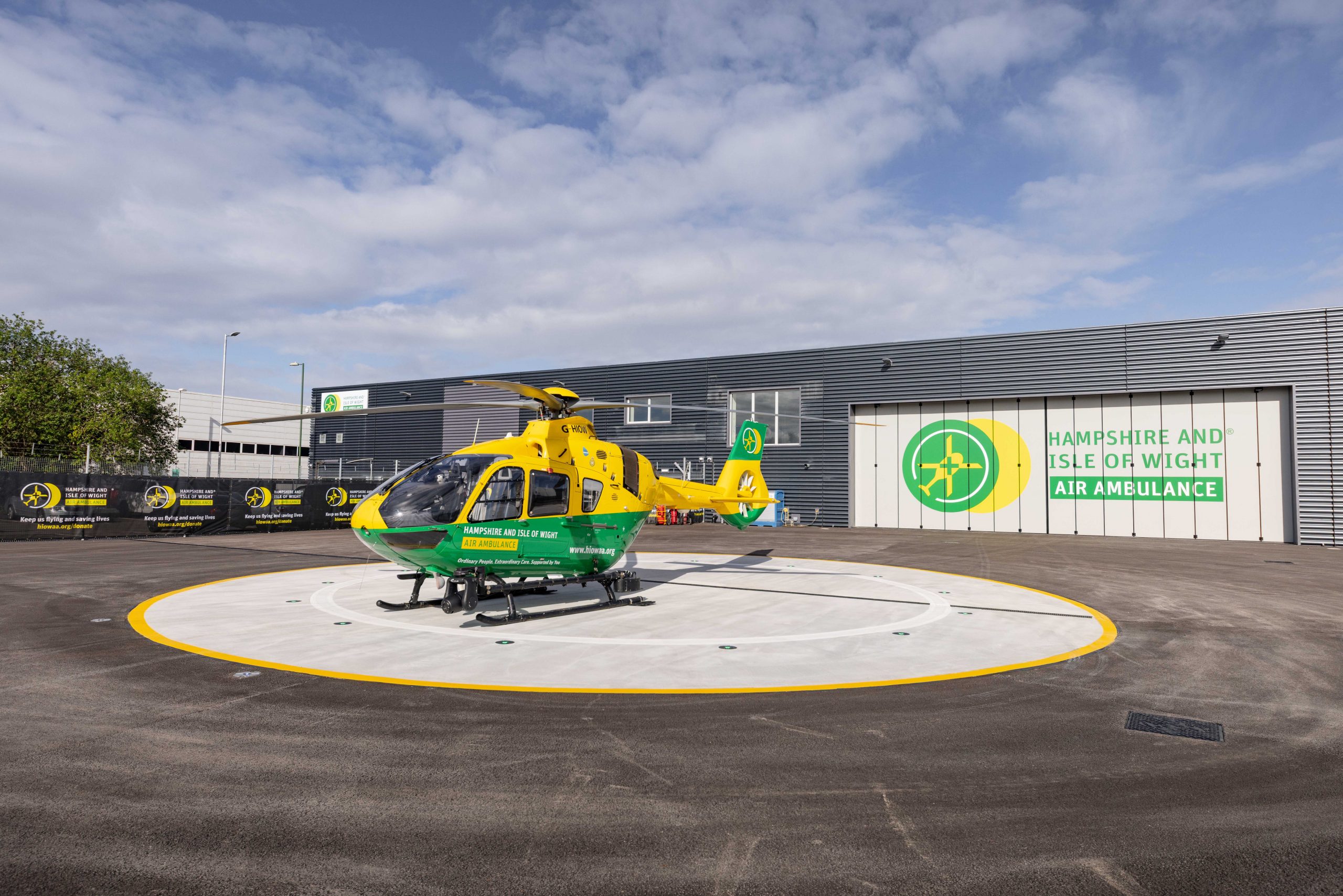
After a serious injury or illness, accessing fast, expert treatment can mean the difference between recovery and lifelong consequences. Every minute can make a difference. The sooner medics can provide critical care, the better the outcome for the patient, so there is a constant search for the next gain that could make a difference to patients.
This constant drive to improve is one of the things that defines air ambulance teams, from reducing the time it takes to reach patients to debriefing after every mission by replaying each step of their patient care to pinpoint improvements, to ensuring the base is operating faster, more effectively, and efficiently.
“It’s about giving someone who has just experienced the worst moment of their life the very best chance of making it home,” says Dr Chris Hill, Hampshire and Isle of Wight Air Ambulance Medical Director and Consultant in Emergency Medicine at University Hospital Southampton.
A consultant in emergency medicine and pre-hospital emergency medicine, Dr Hill has flown with and treated hundreds of patients on board the unit’s Airbus H135 aircraft since 2014. “As emergency doctors, we’re responding to unpredictable environments and, from our new base, often find we are now first on the scene, even before the ambulance service.
“We’re delivering hospital-level care in someone’s home or at the roadside. If a procedure needs to be carried out, a drug administered, or a critical decision made, we need to do that as early as possible. Instead of providing that care 20 or 30 minutes after an injury, we can now do so within five or 10 minutes,” adds Dr Hill.
New Approach, Faster Response
As part of this approach to trauma care, in June 2026, the Hampshire and Isle of Wight Air Ambulance (HIOWAA) officially moved its helicopter emergency medical service operations from Thruxton to a new, purpose-built £3.6 million airbase at Southampton Airport (SOU).
Since its first flight in 2007, the service operated near Andover. However, over time, data showed 70 percent of its emergencies occurred in the south of the region, nearer densely populated cities such as Portsmouth, Southampton, Winchester, and the Isle of Wight.
With crews spending up to 20 minutes flying to reach a patient and another 20 minutes returning to base—costing precious time that critically unwell or injured patients do not have, alongside fuel and funding—the service moved to its two-storey hangar on the edge of SOU in 2026. Available 365-days-a-year, the HIOWAA critical care team has halved its response times and can now reach almost every patient in Hampshire and the Isle of Wight within 10-minutes of take-off. Medics say it is already making a huge difference to patient outcomes, with preliminary data showing teams are reaching patients far quicker than ever—whether attending road traffic collisions, sporting accidents, or other incidents.
Next Generation Air Ambulance Services
The helicopter team operates from a state-of-the-art facility featuring a hangar to house the helicopter, office space, aftercare facilities, on-site crew accommodation, training and briefing rooms, and a garage for the charity’s fleet of emergency response vehicles.
Operating day and night, the helipad is designed to enable the current and next generation of air ambulances to land in all weather conditions, as well as at night with the aid of night-vision goggles. Airfield Lighting Systems (ALS) worked closely with HIOWAA to create a lighting and power control package that meets operational needs while remaining cost-effective for the publicly funded charity, whose life-saving missions cost an average of £3,500 each.
“The new location is incredibly exciting. It’s unlocking so much potential for the future of our service by completely transforming what we can do for patients, and it is already making a significant difference. Almost every day, I see patients whose care would look very different without us, and it is very apparent that helicopter emergency medical services are now an essential cog in the emergency response,” adds Dr Hill. “With a new, more flexible facility at the new location, being able to come back here, reset, and go back out faster—even in challenging conditions—is a powerful thing.
“We’ve already got preliminary data showing we’re getting to patients far quicker than ever before. The sustained picture is already translating into improved outcomes,” concludes Dr Hill.
Using expertise gained from Southampton Airport’s 2024 runway extension, ALS partnered with CAMGO Electrical to supply and commission around 40 airfield lighting fittings across the touch-down and lift-off (TLOF) and final approach and takeoff (FATO) areas. The installation also included a new Constant Current Regulator and a pilot-controlled radio activation system, enabling direct lighting control from the aircraft.
As part of the programme, the team also installed new airfield signs along the existing taxiway and solar-powered runway guard lights in areas of the helipad where conventional power was not possible – the biggest operational focus for ALS as the helipad is located next to Southampton’s main runway.
“By combining our specialised airfield lighting technology with HIOWAA’s operational vision, we’ve delivered a precision system—from pilot-controlled lighting to solar-powered guard units—that ensures safe, emergency landings in all conditions,” said Keith Spicer, Managing Director of Airfield Lighting Systems. “This programme is about more than supplying hardware; it’s about providing the Hampshire and Isle of Wight Air Ambulance team with the dependable infrastructure they need to reach patients faster and save lives now and in the future.”
Click here to learn about the work of Hampshire and Isle of Wight Air Ambulance Service or to discover more about the Airfield Lighting Systems Helipad product portfolio.